
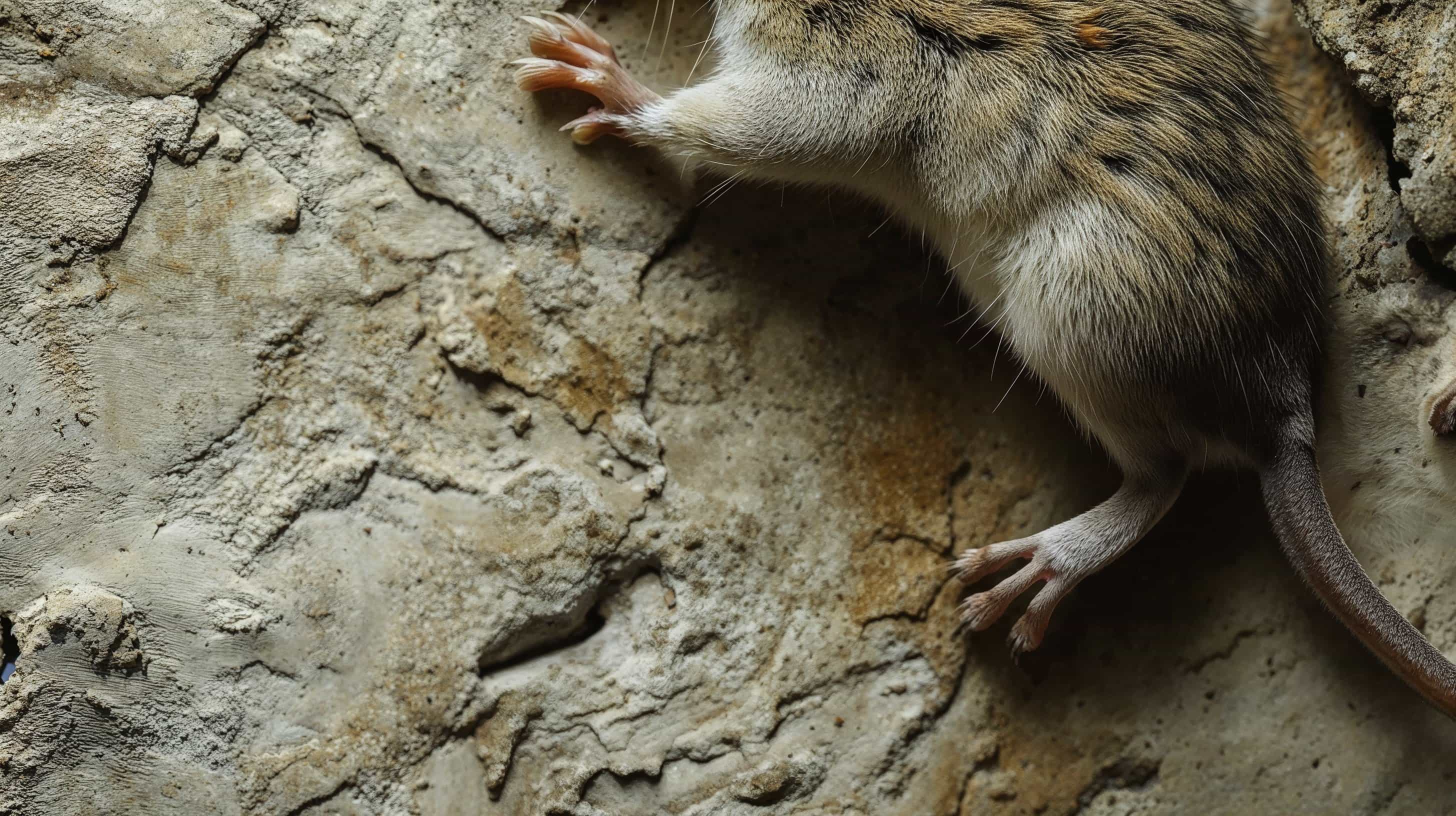
Mice can climb walls, which is why droppings turn up on a counter no mouse seems able to reach and scratching starts inside a wall cavity at night. To a mouse, a wall is a ramp rather than a barrier, and so are the hydro line to the house, the vine on the siding and the pipe that runs between floors.
That changes where the problem gets fixed. Plugging holes at ground level does little when a mouse can reach a gap under the soffit, so what matters is which surfaces give a mouse grip and which ones leave its feet nothing to hold.
Can Mice Climb Walls?
Mice can climb walls, as long as the surface is rough enough to grip. According to UC IPM, house mice are good climbers that can usually run up rough vertical surfaces, and the University of Nebraska-Lincoln Extension says the same about climbing and balancing along wire cables and ropes. A mouse is small and light, usually about 5 to 7 inches (about 13 to 18 cm) long including a 3 to 4 inch tail, and weighs about 1/2 ounce (about 14 grams), so even small bumps and cracks can give it enough grip.
Which Walls Can Mice Climb?
Mice can climb most walls you find in and around a Canadian home. The University of Nebraska-Lincoln lists wood, brick, concrete and even weathered sheet metal as surfaces rats and mice can usually climb. That covers brick and concrete foundations, wood siding, textured stucco, unfinished basement walls and the wooden framing inside your walls. Mice running the same route up a concrete wall can even leave a dark smudge line behind them.
Which Surfaces Can Mice Not Climb?
Mice cannot climb surfaces with a slick finish. According to the Internet Center for Wildlife Damage Management, mice can usually walk up wood or concrete "unless the surface has a slick finish." Smooth, intact metal, glass and glossy coatings give their feet little to hold. Be careful with old metal, though: weathered, scratched or rusty sheet metal is rough enough to climb, so it is not a barrier.
Can Mice Climb Pipes?
Mice can climb and travel along pipes. The University of Nebraska-Lincoln notes that rats and mice can crawl horizontally along pipes and conduit, and they often use these runs as highways between floors and rooms. Pipes that pass through a wall are also one of the main ways mice get inside the wall itself, because the gap around the pipe is rarely sealed.
Can Mice Climb Wires?
Mice can climb wires and balance along them. House mice can run horizontally along wire cables and ropes (UC IPM), and they may use electrical wires, cables and ropes to reach a building (University of Nebraska-Lincoln). Hydro and cable lines that run to your house can work as a bridge.
Can Mice Climb Trees?
Mice may climb trees, vines and shrubs to gain entry to a building, according to the University of Nebraska-Lincoln. A branch that touches your roof or a vine growing up your siding gives a mouse a direct route to the soffits, the roof line and any gap up high.
Can Mice Climb Upside Down?
Mice may be able to hang upside down from screen wire, according to the University of Nebraska-Lincoln. In practice, this means a mesh or screen surface is a climbing surface for a mouse, not a barrier, unless the mesh is fine and strong enough that it cannot squeeze through or chew it.
Can Mice Jump?
Mice can jump about 10 to 12 inches (about 25 to 30 cm) straight up onto a flat surface. The University of Nebraska-Lincoln and the Internet Center for Wildlife Damage Management give about 10 inches, UC IPM gives up to about 12 inches, and one University of Nebraska-Lincoln guide cites up to about 18 inches (about 45 cm). Jumping and climbing together let a mouse get almost anywhere in your home.
How Far Can Mice Jump?
Mice may be able to jump across a gap of about 3 feet (about 90 cm), according to the University of Nebraska-Lincoln Extension. A mouse on a shelf, a stack of boxes or a ledge can reach a nearby counter or opening without touching the floor.
Can Mice Survive a Fall?
Mice can survive a vertical drop of about 9 feet (about 2.7 metres), according to the University of Nebraska-Lincoln Extension. A fall from a wall, a rafter or the top of a cupboard does not stop them.
What Jumping Means for Your Counters
Jumping means your counters, tables and low shelves are well within reach of a mouse, even with nothing nearby to climb. Keep food in sealed containers rather than counting on height. When you trap, UC IPM notes that pairs of traps set 1 to 2 inches (about 2.5 to 5 cm) apart can catch more mice, because mice often jump over a single trap.
Why Do Mice Climb Walls?
Mice climb walls to reach food and nesting sites. The University of Arizona Cooperative Extension explains that house mice often climb vertical surfaces "to reach up to a food source or nesting site." Climbing is usually how they get from where they are to where the food and shelter are.
Food
Food is the first reason mice climb. Counters, upper cupboards, pantry shelves and bird feeders are all within reach of a climbing, jumping mouse. Crumbs on a counter, open cereal boxes and pet food left out are enough to keep them coming back.
Nesting Sites
Nesting sites are the second reason. House mice usually build nests in undisturbed, enclosed spaces, shredding paper, cardboard, fabric and building insulation into loose, ball-shaped nests roughly 4 to 6 inches (about 10 to 15 cm) across (University of Arizona). Wall voids, attics and the spaces above ceilings are exactly that kind of space, which is why climbing leads mice into your walls. See where mice hide in a house for the other common spots.
Shelter in the Fall
Shelter is the reason mice climb into homes in the fall. Canadian pest control companies such as Terminix Canada and Orkin Canada report that mice and other rodents often move indoors as temperatures fall and winter approaches. A mouse that finds a gap high on your wall, at the roof line or around a vent will use it, which is why fall is the best time to check and seal your home.
How Do You Know if There Are Mice in Your Walls?
Mice in walls usually announce themselves with scratching sounds at night. Health Canada lists "scampering and scratching sounds in the walls of your home at night" as a sign of rats and mice. Look for the other signs below to confirm.
Scratching Sounds at Night
Scratching sounds at night are the most common sign of mice in walls. The University of Arizona Cooperative Extension describes the quiet scampering and scratching mice can make in wall voids and above ceilings, plus occasional squeaks, mostly at night. The University of Nebraska-Lincoln also mentions scratching and squeaking from ceilings and walls. Sounds that move up and down inside a wall are mice climbing the framing.
Rub Marks
Rub marks are dark smudges along the routes mice travel over and over, such as baseboards, pipes and other conduits. They often darken over time as oil and dirt rub off the mouse's body (University of Arizona). Clean them with soap and water once you have dealt with the mice.
Pulled-Out Insulation
Pulled-out insulation is a sign that mice are nesting nearby. The University of Arizona notes that finding wall void or attic insulation pulled out or moved to unexpected places may point to mouse activity, and the University of Nebraska-Lincoln warns that mice can quickly destroy insulation in walls.
Droppings Near Walls
Droppings near walls, on counters and in cupboards confirm that mice are active. House mouse droppings are 1/8 to 1/4 inch (about 3 to 6 mm) long, similar in size and shape to grains of rice (University of Arizona). A musky odour is also typical of mice (UC IPM). Learn to tell them apart in our guide to mouse poop, and see the full list of signs of mice.
How Do You Stop Mice From Climbing Into Your Home?
Stopping mice from climbing into your home means removing what they climb on and sealing every gap they could reach. Gaps high up count just as much as gaps at ground level, since mice can climb your walls.
Trim Plants Near the House
Trimming plants is the first step, because plants are ladders for mice. UC IPM advises thinning or removing plants next to or climbing up buildings, since house mice can climb well. Cut back branches that touch the roof, remove vines from the siding, and follow Health Canada's advice to cut tall grass and weeds back from your house.
Seal Gaps With Mouse-Proof Materials
Sealing gaps with mouse-proof materials keeps climbing mice out. Health Canada says mice can squeeze through cracks as small as a dime, and UC IPM says they can get under gaps about 1/4 inch (about 6 mm) tall. Use materials mice cannot chew:
- Coarse steel wool or wire screen usually works in small cracks, and you can stuff steel wool around pipes before caulking (Health Canada, UC IPM). Steel wool pads may rust, so treat them as a temporary plug.
- Copper mesh or stainless steel fibres can work for larger gaps (University of Nebraska-Lincoln).
- Metal weather stripping under doors, and metal on the edges of doors and windows to stop gnawing.
- Concrete, aluminum flashing or 1/4 inch wire mesh can work for larger openings.
Do not rely on expanding foam, rubber, vinyl or plastic alone: UC IPM and the Internet Center for Wildlife Damage Management say these often do not stop mice. To find every opening, follow our guide to finding mouse entry points and read how mice get into your house.
Add Sheet Metal Guards
Sheet metal guards stop mice from climbing a wall at a specific spot. The University of Nebraska-Lincoln suggests attaching aluminum sheet metal bands about 12 to 18 inches (about 30 to 45 cm) wide at least 36 inches (about 90 cm) above the ground, or at floor level, especially at corners. Indoors, sheet metal guards at the interior corners of rooms prevent mice from climbing up. Keep the metal smooth and clean so it stays slick.
Cover Vents
Covering vents closes the high openings that climbing mice target. Health Canada advises covering dryer vents, attic vents and soffits with fine mesh metal screening. Check the roof line and soffits too, not only the foundation.
Trap Mice Already in the Walls
Trapping is how you deal with mice that are already in the walls. The University of Nebraska-Lincoln suggests placing traps or stations where mice may exit the walls, such as along pipes, above drop ceilings and on foundation sill plates, and the Government of British Columbia advises setting traps along walls where rodents travel. Health Canada says baits or poisons should not be your only method, and that any poison bait must be in a tamper-proof bait station wherever children or pets can reach it. Read and follow the label. For trap choices, see the best mouse traps and how to set a mouse trap, and for the full plan, read how to get rid of mice.
When to Call a Professional
Calling a licensed pest control professional makes sense when the scratching continues after a few weeks of trapping, when you cannot find where mice are getting in, or when entry points are high on the house and hard to reach. A professional can inspect the roof line, vents and foundation and seal gaps with rodent-resistant materials.
If you want help, you can get a quote from a recommended local exterminator through Pest Agent's referral form. For more guides on mice, visit our mice hub.
Frequently asked questions
Can mice climb smooth walls like glass?
No. Mice usually cannot climb surfaces with a slick finish, such as glass or smooth, clean metal, because their feet have little to grip. They can still climb any rough surface next to it, such as a window frame or a weathered wall.
Are rats better climbers than mice?
Some rats are. Health Canada describes the roof rat as an agile climber that lives in trees and vines, and rats can often jump higher than mice. House mice can also climb well, though, and their smaller size lets them use much smaller gaps.
Can mice climb stairs?
Yes. Mice can usually climb rough surfaces and jump onto flat surfaces, so each step is a short climb or hop. Stairs, carpeted or not, do not keep mice on one floor.
Does expanding foam stop mice?
No. UC IPM and the Internet Center for Wildlife Damage Management both say expanding foam may not stop mice, because they can chew through it. Consider steel wool, copper mesh, metal or concrete instead, and add foam or caulk only as a finishing layer.
Can mice climb inside walls to the second floor?
Yes. Mice can climb the rough wooden framing inside walls and travel along pipes and wires, so they may move between floors without ever being seen. Scratching sounds that move up and down a wall at night are a common sign.
Dealing with mice right now?
Answer a few short questions and we pass your request to a pest control company ranked near you.
Get a free quote